
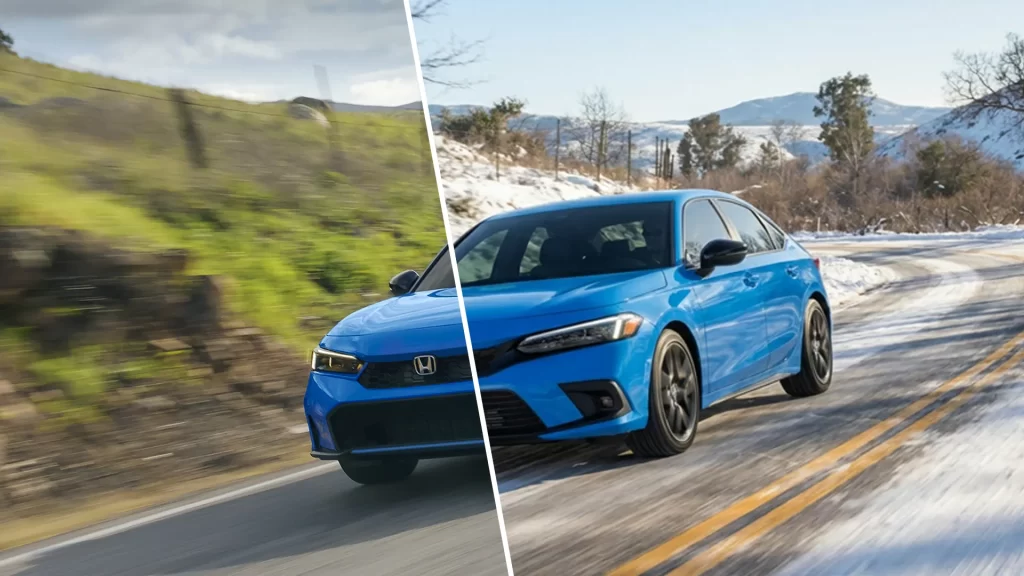
Visual artificial intelligence is playing an increasingly important role in marketing. Image generators offer speed and flexibility, and when used properly, they can become powerful creative allies. As an Art Director at Nerd Marketing, I actively test AI-generated vehicle images and integrate them only when they provide real value.
In automotive marketing, however, visuals leave no room for error. Even subtle inconsistencies—headlights, grilles, badges—can undermine the credibility of a model and the brand presenting it. And it is precisely in these details that AI-generated vehicle images still reveal their limitations.
This article is based on concrete observations drawn from real-world testing in automotive dealership content creation. The goal is to provide a professional, nuanced perspective on the use of AI, while respecting the standards required in art direction and visual consistency.
Why AI-Generated Vehicle Images Lack Fidelity
Image generators operate through visual associations. They analyze massive image datasets to identify recurring patterns, then reassemble a “plausible” image based on those references. In automotive marketing, this recomposition logic presents a clear problem: it does not account for the unique design subtleties of each model.
In practice, this results in visible inconsistencies. Headlights from a previous generation, a grille reminiscent of another model from the same brand, or a bumper design that does not match any official version. These discrepancies may go unnoticed by some, but they are quickly spotted by trained eyes—and especially by brands that care about their image.
From an art direction standpoint, this kind of approximation turns what should be a value-adding visual into a source of doubt.
A Challenge Amplified by New or Redesigned Models
The newer a vehicle is, the greater the risk of error. Recently redesigned models often have limited visual references available: fewer angles, fewer color variations, fewer trims, and visuals that are still tightly controlled by manufacturers.
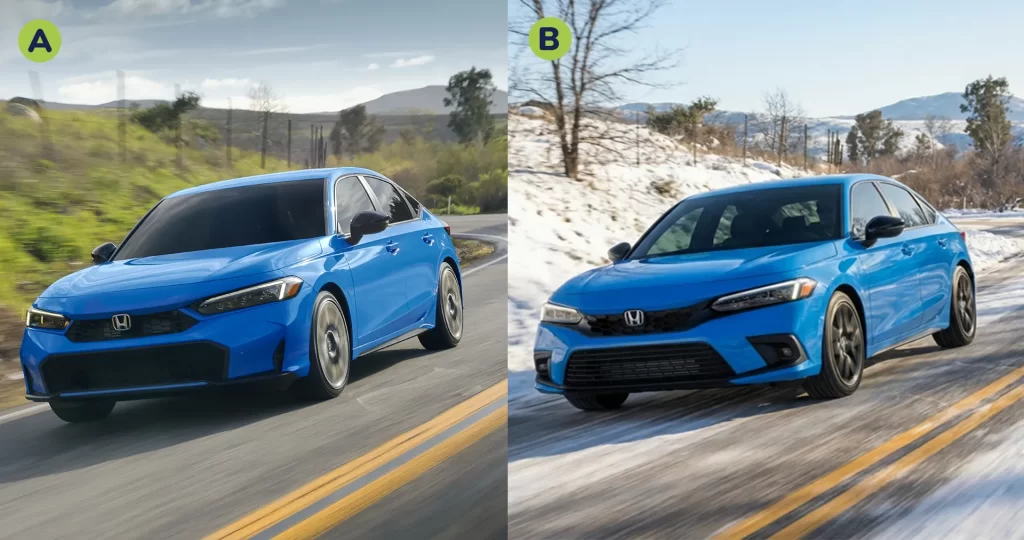
While these changes may not be immediately obvious, they alter the vehicle’s visual signature and no longer reflect the real configuration of the model. This example clearly illustrates how, even when using a precise reference image, AI can reinterpret essential design elements rather than reproduce them faithfully.
In these situations, AI fills in the gaps with what it already “knows”—drawing from previous generations, concept cars, or related models. The result may appear credible at first glance, but it does not accurately represent the vehicle’s true design.
In an industry where every redesign is strategic and meticulously planned, these visual shifts can blur the message and dilute the model’s identity.
Why a Reference Image Is Not Always Enough
It is tempting to believe that providing a precise reference image will eliminate these issues. In reality, the reference image mainly guides AI on general elements such as proportions, stance, or atmosphere. It does not guarantee strict adherence to design details.
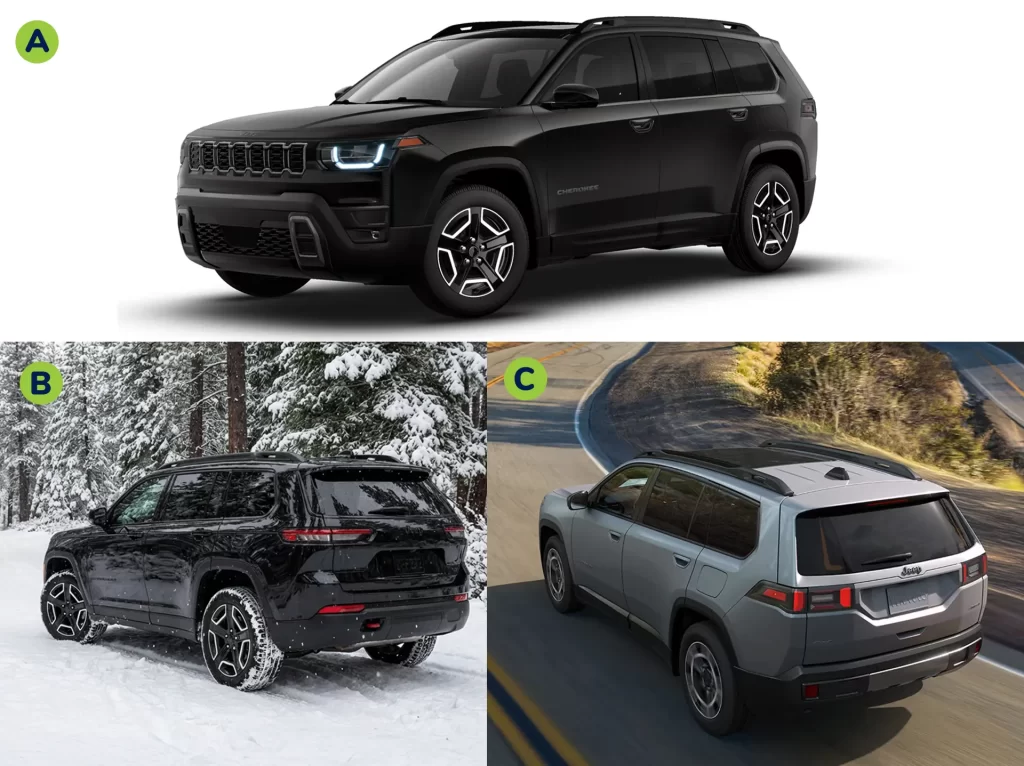
Common Errors on Recent Models with AI-Generated Vehicle Images
As soon as the angle, lighting, or environment changes, AI interprets the vehicle again. It adjusts, simplifies, or transforms elements without distinguishing between essential design choices and purely decorative details. This limitation is structural and inherent to how these tools function.
Blurred Logos, Badges, and Model Names: A Well-Known Limitation
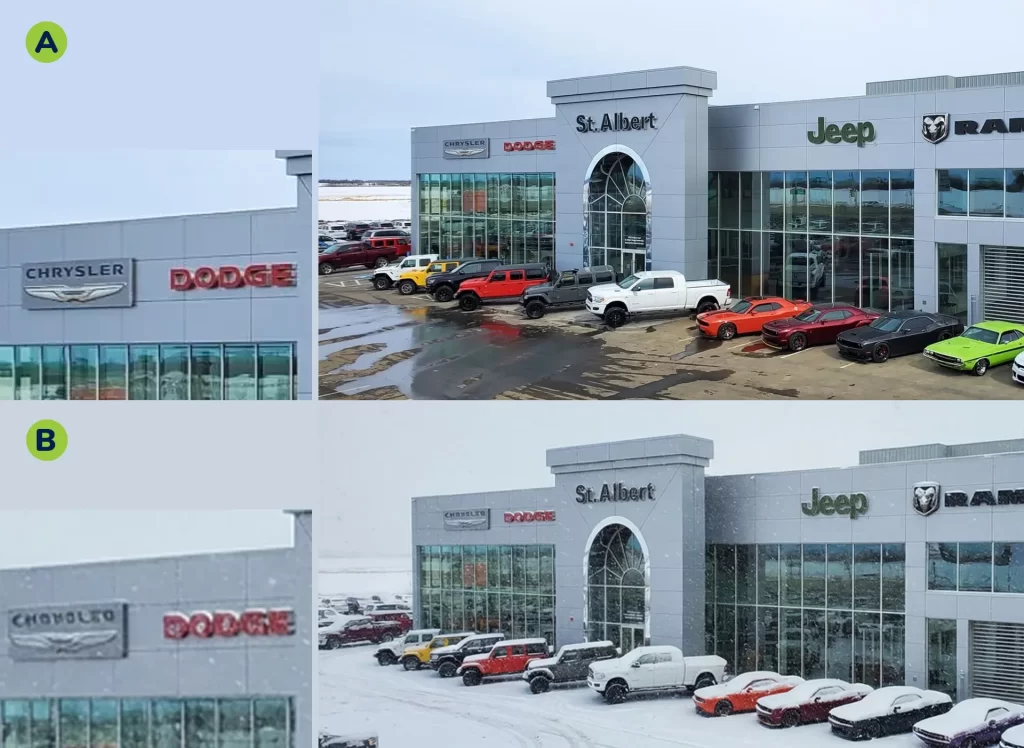
Logos, badges, and model names are among the elements most frequently altered in AI-generated images. Distorted text, inaccurate typography, and partially legible emblems are common issues.
This is due to two main factors. First, image generators have historically struggled with precise text rendering. Second, there is an implicit tendency to avoid overly faithful reproduction of registered trademarks. The result is an image that may look realistic from a distance but quickly loses credibility upon closer inspection.
In automotive marketing, these elements are never secondary. They carry brand identity and recognition. When they become blurred or approximated, the entire message weakens.
AI-Generated Vehicle Images for Dealership Building Photography
When AI Becomes a Relevant Tool in Automotive Marketing
These limitations do not mean that visual AI has no place. When used in the right context, it can enrich a creative strategy and speed up certain production stages.
AI is particularly effective for:
- atmospheric visuals
- creative or exploratory concepts
- backgrounds or staging
- teaser or inspirational content
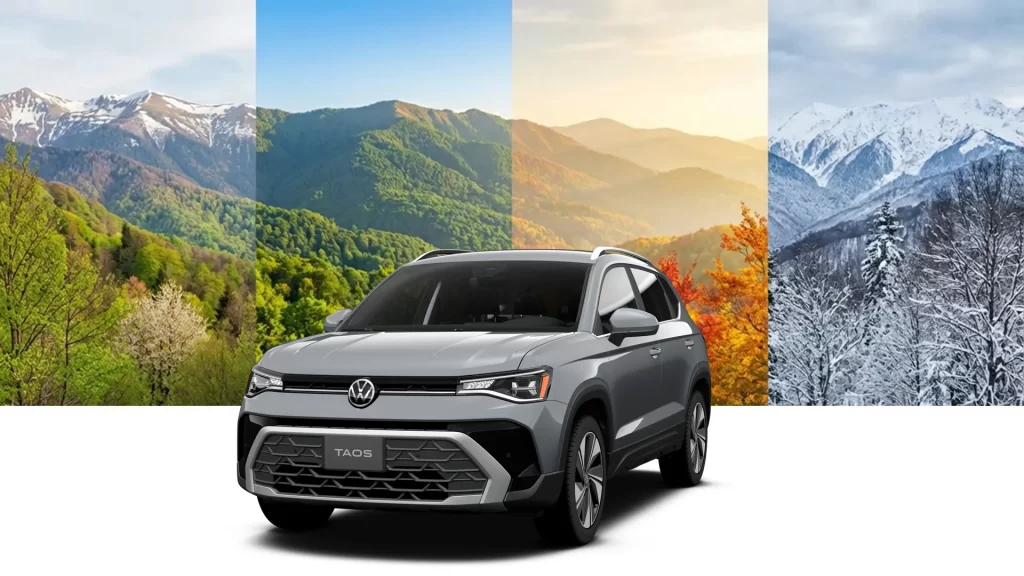
In these cases, the vehicle is not presented as an official reference but as a narrative element, significantly reducing the risk of confusion.
When Using AI Becomes Risky
Conversely, certain uses carry significant risks and should be avoided:
- model pages
- vehicle detail pages
- comparisons
- official advertising campaigns
- transactional content
Whenever the goal is to inform accurately or represent a vehicle faithfully, AI cannot replace manufacturer-approved images or certified 3D renders.
The Recommended Approach: AI Supported by Human Art Direction
The healthiest solution is a hybrid approach. Artificial intelligence can support creation, open visual exploration, and accelerate certain processes. However, art direction remains essential to ensure consistency, credibility, and compliance.
AI is a powerful tool. Responsibility for the visual remains human.
AI-Generated Vehicle Images Used for Backgrounds Only
Conclusion – AI Is Not the Problem, Usage Is
Visual artificial intelligence offers exciting possibilities in content creation. It enables exploration, rapid iteration, and expanded creative boundaries. However, in automotive marketing, visual accuracy is not a luxury—it is a requirement.
AI-generated vehicle images still have clear limitations in terms of fidelity and consistency. These discrepancies, sometimes subtle, can weaken a brand’s credibility when used without structure or discernment.
The role of art direction therefore remains central. It ensures the right choices are made, the proper boundaries are set, and AI is used where it truly adds value—without compromising brand image. AI can support creation, but it does not replace human judgment or the responsibility tied to public-facing visuals.
Need guidance on using AI in automotive marketing? Feel free to contact us.
Eric Boissonneault